ERP HR Module

An ERP HR module is the part of an Enterprise Resource Planning system that handles everything related to people — employee records, payroll, attendance, recruitment, performance, training, and compliance — all from one place.
What makes it different from a standalone HR tool (an HRMS or HRIS) is that it's wired into the rest of the business. When payroll runs, the numbers flow straight into the finance module's general ledger. When a new hire joins, IT, finance, and operations all see it without anyone forwarding a spreadsheet. Nothing gets re-entered, nothing falls through the cracks.
The shift is well underway. A 2023 report found that 41% of ERP users have already integrated their HR processes — more than any other module, ahead of marketing, customer service, procurement, and manufacturing. And 74% of companies plan to spend more on HR technology, mostly because the operational savings are real.
Core Functions of an ERP HR Module
Most ERP HR modules cover the same core ground. Here's what each function actually does:
Function | What It Handles |
| Employee Data Management | A single, secure database for every employee record — personal details, job history, documents, certifications. Replaces scattered files and spreadsheets. |
| Payroll Processing | Automates salary calculations, tax deductions, benefits, and payslips. Syncs directly with the finance module. |
| Time & Attendance | Tracks working hours, shifts, leaves, and overtime — often pulled from biometric scanners or login systems. Feeds straight into payroll. |
| Recruitment & Onboarding | Manages job postings, applications, interviews, offers, and digital onboarding paperwork. 58% of businesses now use HR tech for hiring (PwC). |
| Performance Management | Goal setting, appraisals, continuous feedback, and performance reviews — with the data stored centrally for trend analysis. |
| Training & Development | Tracks training plans, certifications, skill mapping, and career progression. |
| Compliance | Keeps the company aligned with local labor laws, tax rules, and statutory reporting requirements. Especially important in regulated regions. |
| Reporting & Analytics | Dashboards and reports on turnover, hiring effectiveness, labor costs, leave patterns, and more — so HR isn't guessing. |
Most modules also handle the messier edges of the employee lifecycle: shift management, leave allocation and encashment, loan applications, expense claims, travel requests, exit interviews, and full-and-final settlements.
Advantages of an ERP HR Module
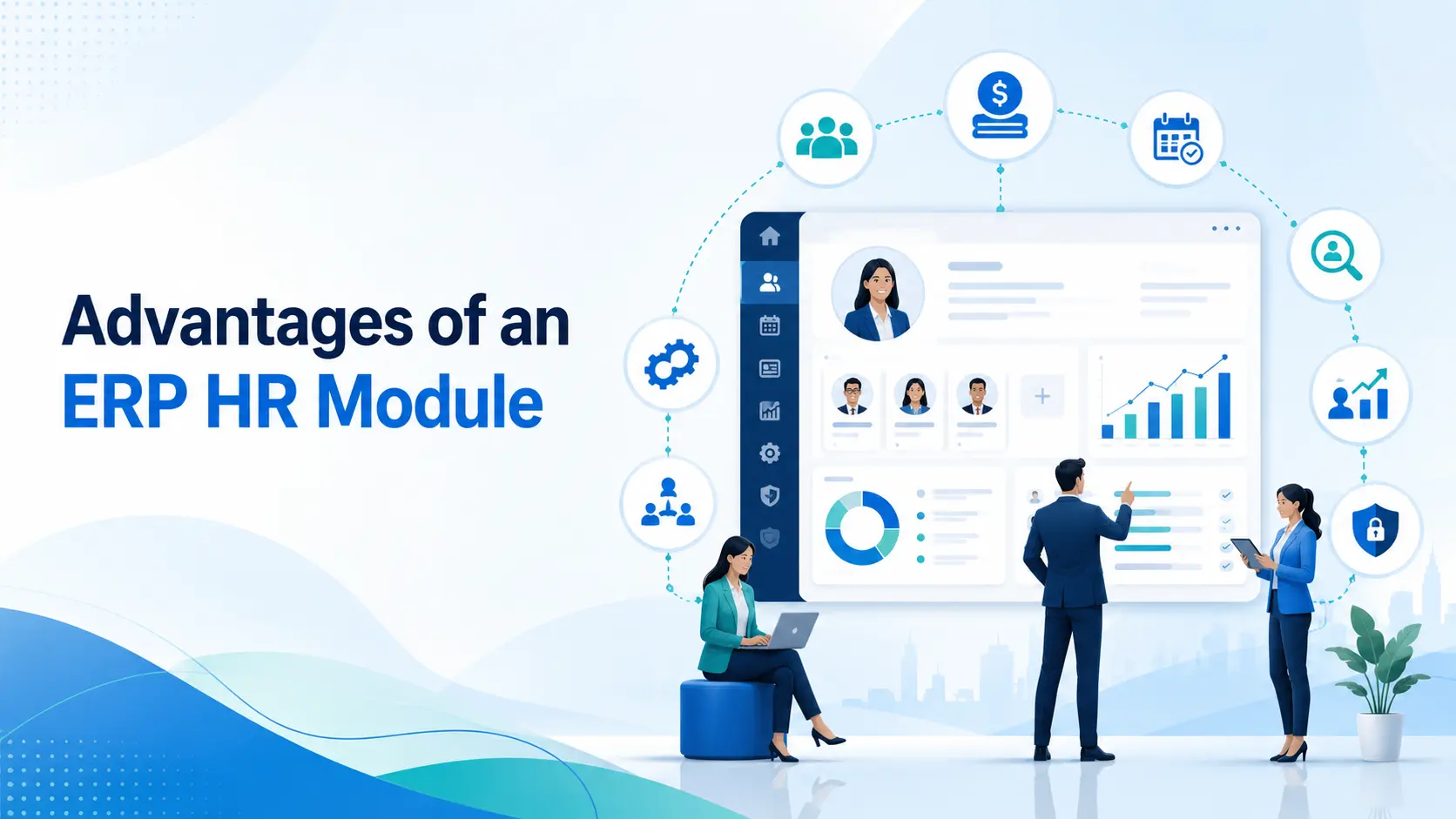
The biggest win is that HR stops being an island.
Cleaner data. When everyone reads from the same database, you don't get the classic mismatch where HR has one headcount, finance has another, and nobody knows which is right. Data duplication and manual entry errors mostly disappear.
Less busywork. Routine tasks — payslips, leave approvals, onboarding checklists, compliance reports — run automatically. The HR team gets time back for the work that actually matters: engagement, culture, training, retention. This matters: 75% of senior HR managers say strong communication and information flow between managers and teams is a requirement for a high-performing workplace and an ERP makes that flow possible.
Better decisions. With real-time data and proper analytics, leadership can spot problems early — rising turnover in one team, a hiring funnel that's stalling, training that isn't translating to performance — and act before they get expensive.
Cross-department workflows. Payroll feeds finance. Headcount plans feed budgeting. Staffing levels feed logistics and operations scheduling. Cost center data ties HR spend to the right parts of the P&L. None of this is possible when HR runs on its own software.
Compliance becomes easier. Tax rules, labor laws and statutory filings — the system handles the reporting and flags issues before they turn into penalties.
Works for distributed teams. Cloud-based ERP HR modules make hybrid and remote work much easier to manage — attendance, approvals, payroll, document access, all from anywhere.
One honest caveat: ERP systems are complex, and an HR team moving from simple tools to an integrated ERP will need training and time to adjust. The payoff is real, but the rollout isn't free.
Examples in Modern HR ERPs
Most major ERP vendors now offer a strong HR module, either built in or as a tightly integrated cloud product:
- SAP SuccessFactors — SAP's cloud HR suite, integrated with S/4HANA. Deep functionality across talent management, payroll, learning, and analytics. Built for large enterprises with global workforces.
- Oracle HCM Cloud (Fusion) — Oracle's flagship HR product, often paired with NetSuite for mid-sized companies. Strong on workforce planning and analytics.
- Workday — Workday made its name in HR before expanding into finance. Especially popular with tech, services, and large knowledge-work companies.
- Microsoft Dynamics 365 Human Resources — Modular, integrates tightly with the Microsoft stack (Teams, Outlook, Azure). Good fit for mid-market companies already in the Microsoft ecosystem.
- ERPNext — Open-source, with a comprehensive HR module covering the full lifecycle: recruitment, onboarding, payroll, attendance, leave, training, performance, expenses, exit. Strong in India, the Middle East, and Africa.
Odoo is worth its own paragraph because it changes the math for smaller businesses. It's an open-source, modular ERP, which means you can start with just the HR app — or HR plus Payroll, Recruitment, Attendances, and Time Off — and add more as you grow. The HR features are genuinely solid: employee directory, contracts, recruitment pipelines, attendance with biometric integration, leave management, expense claims, appraisals, and payroll. Where it's lighter is in heavy-enterprise capabilities like sophisticated global payroll across dozens of countries or deep talent management analytics. For a 30-person startup or a 300-person regional business, that's not a problem.
The pricing gap is the real story. Odoo can run for a low monthly fee per user (or free if you self-host), while SAP SuccessFactors or Workday typically cost tens to hundreds of thousands a year once you factor in licenses, implementation, and consulting. For a small or mid-sized business that wants a proper integrated ERP without the enterprise price tag, Odoo is one of the most practical options on the market.
The right HR module is the one that matches your size, your geography, and how complex your workforce actually is. A 40-person agency doesn't need SuccessFactors. A 40,000-person manufacturer probably can't run on Odoo. Match the tool to the job.
Ready to estimate your app cost?
Use our free calculator to get a personalised cost breakdown in 2 minutes.
Calculate Your App Cost