What Is Adaptive Software Development? A Complete Guide
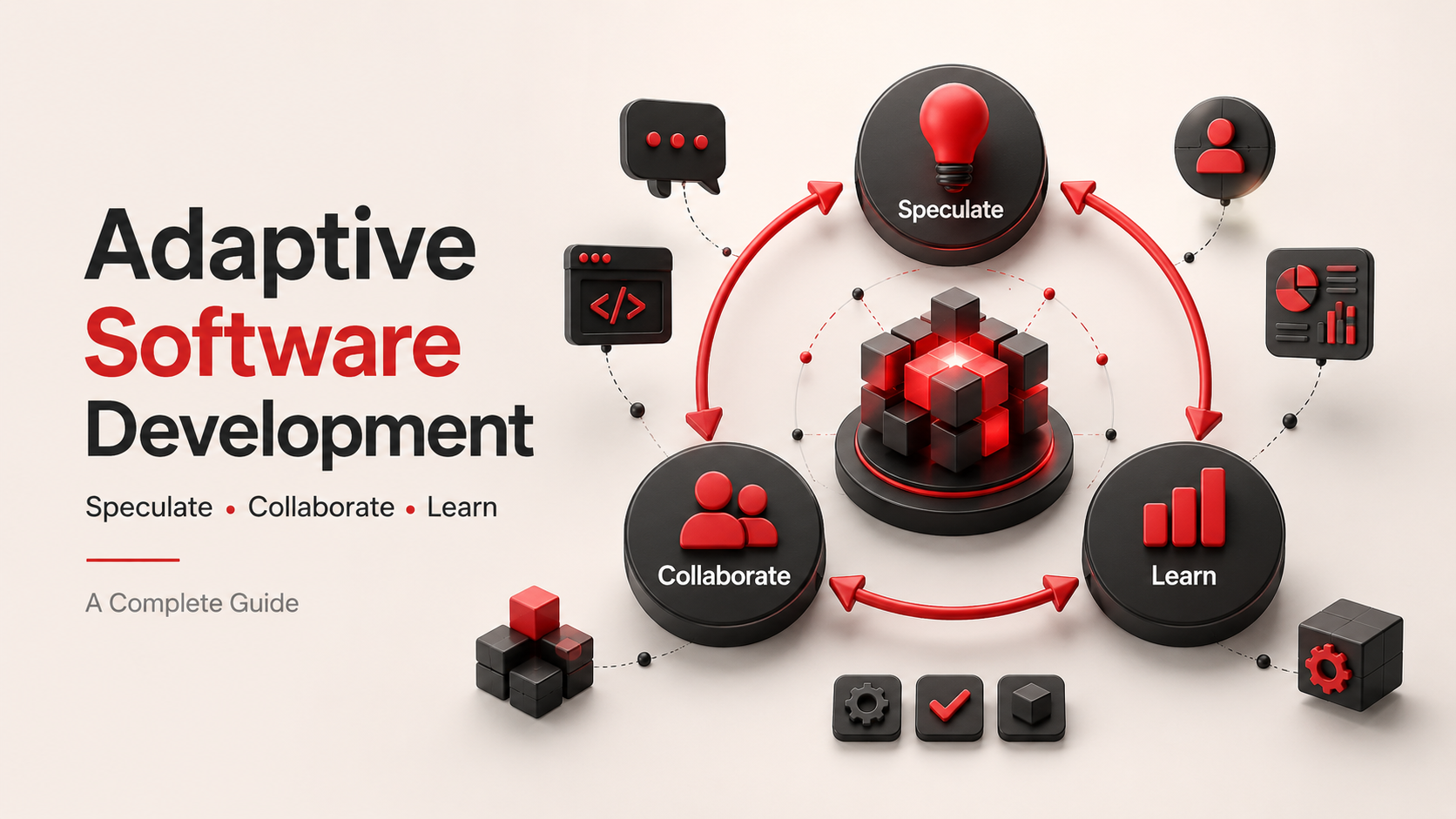
Software requirements rarely sit still. A founder pivots in week three, a regulator rewrites the rules in week six, and a feature that felt essential at kickoff turns out to be noise by launch day. Adaptive Software Development (ASD) is a methodology built for that reality. Jim Highsmith and Sam Bayer introduced it in the mid-1990s as a deliberate alternative to the rigid "plan, build, implement" loop of traditional engineering. ASD replaces that loop with three phases: speculate, collaborate, learn. Teams that work this way assume change is the default, not the exception, and they structure every iteration around discovery. Modern software development practices borrow heavily from ASD, even when teams label their workflow Agile, Scrum, or something custom.
ASD fits best when the destination is clear but the route isn't. Startups building a web application for a market that doesn't yet exist lean on it to test ideas fast. Product teams shipping a mobile app under competitive pressure use it to absorb user feedback between releases. Enterprises modernizing a legacy desktop application reach for it when stakeholder lists are long and opinions conflict. Even wearables firms writing firmware for a smart watch app benefit from it, because hardware constraints often surface only after real users wear the device.
The same logic applies to faster-moving formats. A marketing website tied to a campaign launch can't survive a six-month requirements document. No-code development begs for adaptive cycles, since teams can ship and revise features in hours rather than sprints. In blockchain projects, where protocol upgrades and gas-fee economics shift quarterly, plan-everything-upfront moves closer to fiction than strategy. Creative-economy work, like NFT development, follows the same pattern, rewarding teams that ship a small drop, read the market, and iterate.
The Origins of Adaptive Software Development
Highsmith introduced ASD in a 1997 paper and expanded it in his 2000 book Adaptive Software Development: A Collaborative Approach to Managing Complex Systems. He drew the idea from complex adaptive systems theory in biology and economics, the same body of work that explains how ant colonies coordinate without a manager and how stock markets self-organize. His argument was straightforward: the more uncertain a project, the worse a linear plan performs. Four years later, Highsmith helped author the Agile Manifesto, which absorbed much of ASD's philosophy into a broader movement.
The Three Phases of ASD: Speculate, Collaborate, Learn
ASD replaces the traditional plan-build-implement sequence with a continuous loop made of three phases.
1. Speculate
Teams don't "plan" because planning assumes the answer is knowable. They speculate. The team defines the mission, sketches a product vision, and identifies a first set of features to chase. The vocabulary matters. Calling the roadmap a speculation tells everyone in the room that revising it later is a feature of the process, not a sign of failure.
2. Collaborate
Building anything novel needs more conversation than coordination. The collaborate phase emphasizes tight cycles between developers, designers, product managers, and customers. Decisions happen in working sessions rather than one-way handoffs, and the team treats every meeting as a chance to absorb new information.
3. Learn
Every iteration ends with a review. Developers demo working code to real users when possible, the team measures results against the mission, and the next speculate phase begins with whatever they just learned. ASD treats learning as a deliverable in its own right. A sprint that ships clean code but teaches the team nothing counts as a weak sprint.
Core Characteristics of Adaptive Software Development
Highsmith described six traits that define an ASD team:
- Mission-driven. Every iteration ties back to a stated mission. Without one, "adaptive" slides into "directionless."
- Feature-based. Work gets sliced by user-facing features, not by technical layers.
- Iterative. Cycles run short. Highsmith originally suggested four to eight weeks, and most modern teams run even tighter.
- Time-boxed. Each iteration has a hard deadline. Scope flexes; the calendar doesn't.
- Risk-driven. Teams attack the riskiest part of the build first, the part most likely to derail the project later.
- Change-tolerant. A new requirement mid-sprint counts as information, not a crisis.
Adaptive Software Development vs Other Methodologies
ASD sits alongside Waterfall, Scrum, Kanban, and Extreme Programming (XP), but it has a different center of gravity.
ASD vs Waterfall. Waterfall assumes requirements are fixed and the team's job is execution. ASD assumes requirements will move and the team's job is discovery. A government compliance project might suit Waterfall. A consumer mobile app rarely does.
ASD vs Scrum. Scrum is a framework with defined roles, ceremonies, and artifacts. ASD reads more like a philosophy. Many Scrum teams already practice ASD principles without naming them. Where Scrum prescribes the daily standup, ASD asks whether yesterday taught the team anything worth changing today.
ASD vs DevOps. DevOps shrinks the gap between writing code and running it. ASD shrinks the gap between assuming and knowing. The two pair well, since faster deployment lets the learn phase happen sooner.
When Should You Use Adaptive Software Development?
ASD earns its keep in three situations:
- High uncertainty. You don't yet know what users want, what the regulator will allow, or what the technology can do.
- Compressed timelines. You need to ship before the market answers your questions for you.
- Cross-disciplinary teams. Product, engineering, design, and operations each hold pieces of the puzzle, and no single role can drive the project alone.
For small, stable, well-understood projects, simpler methods work fine. For large, novel, fast-moving projects, ASD's emphasis on learning over planning starts to pay off quickly.
Final Thoughts
Adaptive Software Development is a stance more than a recipe. It starts from the assumption that software gets built under uncertainty, and treats every iteration as a chance to reduce that uncertainty. Teams that adopt it ship faster, waste less, and arrive at better products, because they stop defending the first plan and start treating change as the work itself.
Ready to estimate your app cost?
Use our free calculator to get a personalised cost breakdown in 2 minutes.
Calculate Your App Cost