ERP Finance Module Explained

The finance module is the core of any ERP system. It's where all the money-related activity in a business gets recorded, tracked, and reported — general ledger, invoices, payments, assets, taxes, budgets, and the financial statements that come out the other end.
What makes it different from a standalone accounting tool is that it's wired into everything else in the ERP. When sales close a deal, the finance module sees the revenue. When procurement places an order, it sees the liability. When inventory moves, it sees the cost. Nothing gets re-typed, nothing gets missed, and the numbers stay current in real time.
If the rest of the ERP is the body of the business, the finance module is the nervous system that keeps score.
Core Components of an ERP Finance Module
A finance module of ERP bundles together what used to be a stack of separate accounting tools. The pieces that almost always show up:
General Ledger (GL). The central record of every financial transaction in the business. This is what the balance sheet, income statement, and other reports get built from. Every other component eventually feeds into it.
Accounts Payable (AP). Tracks what you owe to vendors and suppliers. Handles invoice intake, approvals, and payment processing. Helps make sure bills get paid on time without duplicate or fraudulent payments slipping through.
Accounts Receivable (AR). The opposite of AP — tracks what customers owe you. Generates invoices, applies payments, and flags overdue accounts. Good AR functionality directly improves cash flow.
Cash and Banking Management. Connects to your bank accounts, tracks balances, reconciles transactions, and gives you a real-time view of cash position. Often handles multi-currency and foreign exchange too.
Fixed Asset Management. Tracks the lifecycle of physical and intangible assets — purchase, depreciation, maintenance, disposal. Important for tax purposes and for understanding what the business actually owns.
Tax Management. Calculates taxes, keeps up with changing regulations, and produces the records needed for filing and audit. Especially valuable for businesses operating across multiple jurisdictions.
Financial Reporting and Analytics. Generates the standard reports — P&L, balance sheet, trial balance, aging reports — plus dashboards and custom views for whoever needs them.
Budgeting and Forecasting (FP&A). Lets you set budgets, track actuals against them, and project future performance using current data instead of disconnected spreadsheets.
Risk Management and Compliance. Audit trails, approval workflows, segregation of duties and internal controls. Makes the system audit-ready and reduces the chance of fraud or compliance failures.
Benefits of an ERP Finance Module
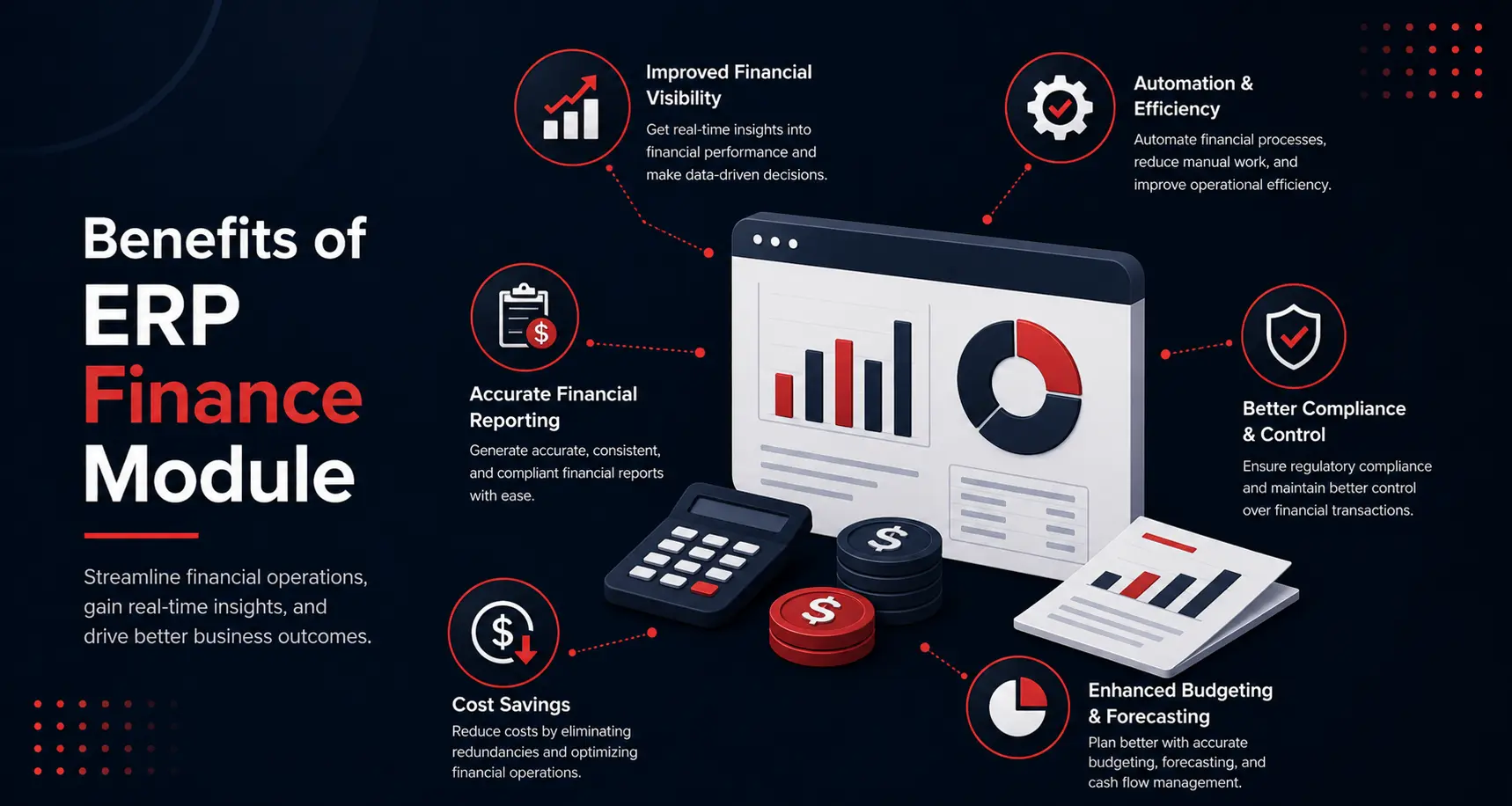
The reason companies bother with all this:
Real-time visibility. Instead of waiting until month-end to know how the business is doing, leaders see current numbers whenever they look. A sale recorded this morning is reflected in cash flow projections this afternoon.
Automation: Reduces manual data entry and errors by automating transactions and reporting.
Faster financial close. Companies stuck on fragmented systems often spend 20–25 days closing the books each month. With an integrated finance module, that drops dramatically because data flows automatically and reconciliations happen in the background.
Less manual work, fewer errors. A purchase order automatically becomes an invoice. Bank transactions reconcile themselves. The finance team stops being data-entry clerks and starts doing actual analysis.
Stronger compliance. Every transaction has an audit trail. Approval workflows make sure the right people sign off. Tax calculations stay current with regulations. This matters more than people realize until they get audited.
Better decisions. When leaders have accurate, real-time data, they make sharper calls — about pricing, hiring, investments, where to cut costs. Bad data leads to bad decisions, and a finance module that's plugged into everything is the cleanest source of truth most companies will have.
Lower costs. No more paying for five separate tools that each do a slice of finance. No more duplicate work as data passes between systems. No more fixing errors that came from someone fat-fingering a number into a spreadsheet.
Profitability tracking. Because the finance module sees data from every department, you can drill into which products, services, customers, or projects actually make money — and which quietly lose it.
Finance Modules in Major ERPs
Most major ERPs cover the same core finance ground, but they differ in depth, complexity and price. Here's a rough comparison of what their finance modules typically include:
Feature | SAP S/4HANA | Oracle NetSuite | MS Dynamics 365 Finance | Odoo |
| General Ledger | Yes | Yes | Yes | Yes |
| AP / AR | Yes | Yes | Yes | Yes |
| Cash & bank management | Yes | Yes | Yes | Yes |
| Fixed assets | Yes | Yes | Yes | Yes (via app) |
| Multi-currency | Yes (advanced) | Yes | Yes | Yes |
| Tax management | Yes (global) | Yes (global) | Yes | Yes (regional packs) |
| Budgeting & forecasting | Yes (advanced FP&A) | Yes | Yes | Basic |
| Financial consolidation | Yes (built-in) | Yes | Yes | Limited |
| Audit trail & compliance | Yes (enterprise-grade) | Yes | Yes | Yes |
| Real-time reporting | Yes | Yes | Yes | Yes |
| Typical user | Large multinationals | Mid-market to enterprise | Mid-market to enterprise | Small to mid-market |
| Pricing | High | High | Mid–high | Low (open-source option available) |
SAP, Oracle NetSuite, and Microsoft Dynamics 365 are built for serious financial complexity — multiple legal entities, multi-currency consolidation, cross-border tax, advanced FP&A. They cost a lot and take time to implement, but for a global company with thousands of transactions a day, that depth is the point.
Odoo takes a different approach. It's modular and open-source, which means you start with the Accounting app and add others (Invoicing, Expenses, Documents, Spreadsheet) as you need them. The core finance functionality is genuinely solid — GL, AP, AR, multi-currency, tax, bank reconciliation, reporting — and it covers what most small and mid-sized businesses actually need. Where it's lighter is in heavy-enterprise features like multi-entity consolidation or sophisticated treasury management. For a 20-person services company or a 200-person distributor, that's not a problem. For a global manufacturer with 15 subsidiaries, it might be.
The pricing gap is the biggest practical difference. Odoo can run for a few hundred dollars a month (or free if self-hosted), while a SAP or NetSuite finance deployment typically runs into tens or hundreds of thousands a year. Match the tool to the actual complexity of your finances.
Common Financial Functionalities
Beyond the core accounting pieces, most finance modules also handle a layer of broader financial functions:
- Financial Planning & Analysis (FP&A) — budgeting, forecasting, variance analysis, scenario modeling.
- Tax Compliance: Ensures accurate tax calculation and reporting based on regulations.
- Multi-currency Support: Converts and tracks transactions across different currencies.
- Risk & Audit Control: Maintains audit trails and internal controls to reduce fraud risk.
- Profit Tracking: Measures profitability at company, department, or product level.
- Treasury management — cash positioning, liquidity planning, investment tracking.
- Revenue management and recognition — handling complex revenue rules, especially for subscriptions or long-term contracts.
- Expense management — employee expense reports, approvals, reimbursements.
- Vendor management — contracts, performance tracking, terms.
- Profitability analysis — by product, customer, region, or project.
- Intercompany transactions — for businesses with multiple legal entities.
- Financial consolidation — rolling up numbers from subsidiaries into a parent view.
Not every business needs all of these. A small company can probably ignore intercompany transactions and consolidation. A multinational can't. The right finance module is the one that covers what you need today without making you pay for capabilities you'll never touch — while leaving room for the ones you'll grow into.
Ready to estimate your app cost?
Use our free calculator to get a personalised cost breakdown in 2 minutes.
Calculate Your App Cost